Travel to Singapore
Day 2 Chinatown
We began the second day of our stay in Singapore by exploring Chinatown on foot, starting directly from our accommodation on Pagoda Street. This district was established during the early decades of British rule following the urban plan designed by Sir Stamford Raffles in 1822. It became the center of the Chinese community, with different areas traditionally occupied by immigrants from various regions of southern China. Today, Chinatown combines preserved nineteenth-century shophouses with temples, markets, restaurants, and modern commercial spaces. Many of the original two- and three-story buildings have been restored and now house cafés, souvenir shops, and cultural institutions. The streets remain arranged according to the original urban layout, allowing visitors to explore the neighborhood entirely on foot. Throughout the district, bilingual information panels explain the history of individual buildings and the development of Chinatown as one of Singapore's oldest commercial and residential quarters. Early in the morning, many shops were just opening, while delivery vehicles supplied restaurants and market stalls before the busiest hours of the day.

Singapore - Masjid Jamae
Our walk began along Pagoda Street, one of Chinatown's busiest pedestrian streets. Historically, this street formed part of the commercial heart of the district, where merchants traded textiles, medicines, tea, and imported goods. Today, the restored shophouses accommodate souvenir stores, craft shops, cafés, and small businesses, while temporary stalls occupy the center of the street. During our visit, the decorations installed for the Mid-Autumn Festival were still suspended above the road, with rows of lanterns stretching between the buildings. The architecture follows the traditional shophouse design, with covered walkways known as the five-foot way, originally intended to protect pedestrians from both tropical rain and intense sunlight. Informational signs along the route describe the different architectural styles visible on the façades, including Chinese, Malay, and European influences. From Pagoda Street, we continued west toward one of Singapore's oldest mosques.

Singapore - Sri Mariamman Temple entrance
Our next stop was Masjid Jamae (Chulia), one of the earliest mosques established in Singapore. It was founded by Tamil Muslim immigrants from southern India during the 1820s and occupies a prominent position at the entrance to Chinatown. The mosque presents a distinctive architectural combination, with South Indian influences visible in its entrance gateways while the prayer hall incorporates simpler colonial features. Although relatively modest in size, Masjid Jamae remains an active place of worship serving Singapore's Muslim community. Visitors are welcome outside prayer times, provided they dress appropriately and respect religious practices. Information panels explain the mosque's historical role in supporting merchants and sailors arriving from India during the nineteenth century. The building illustrates the close proximity of different religious communities within Chinatown, where mosques, Hindu temples, Buddhist temples, and Chinese shrines stand only a short distance from one another.
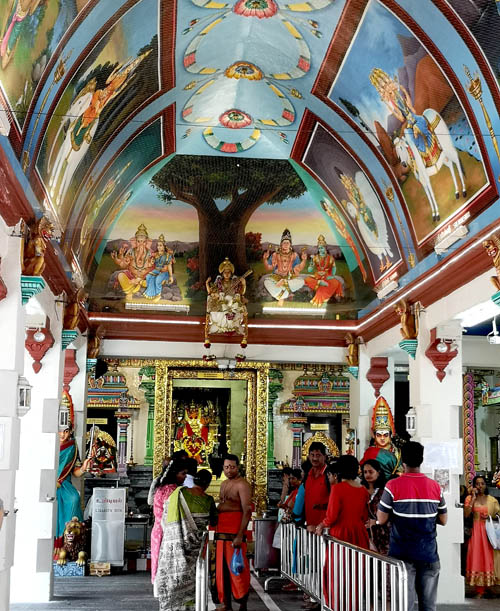
Singapore - Sri Mariamman Temple
A few steps away stands the Sri Mariamman Temple, the oldest Hindu temple in Singapore. Built in 1827, it was originally established to serve Tamil immigrants who arrived during the British colonial period. The temple is dedicated to Goddess Mariamman, traditionally associated with healing and protection against disease. The most striking feature of the complex is its colorful gopuram, or entrance tower, covered with hundreds of sculpted figures representing Hindu deities, mythological characters, and sacred animals. Inside the temple complex, several shrines surround an open courtyard where religious ceremonies continue to take place throughout the year. The temple also hosts one of Singapore's most important Hindu festivals, Theemithi, during which participants perform the traditional fire-walking ceremony. Visitors may enter designated areas after removing their shoes, while photography is permitted only in certain sections. Informational displays explain the symbolism of the sculptures and the significance of the temple within Singapore's Hindu community.
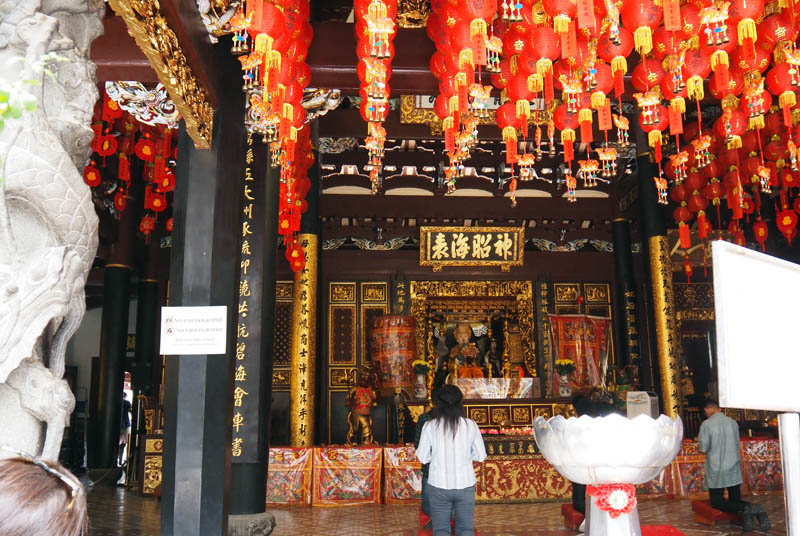
Thian Hock Keng Temple
From there, we continued toward the Thian Hock Keng Temple, whose name translates as the Temple of Heavenly Happiness. Completed in 1842, it is considered the oldest Hokkien temple in Singapore and is dedicated primarily to Mazu, the Chinese goddess of the sea and protector of sailors. Before land reclamation altered Singapore's coastline, the temple stood directly beside the waterfront, allowing newly arrived Chinese immigrants to give thanks after safely completing their sea voyage. The temple was constructed entirely without nails, using traditional Chinese building techniques, and incorporates intricate carvings, ceramic decorations, stone lions, and elaborately painted wooden beams. The interior contains several halls dedicated to different deities, while incense burners and offering tables remain in active use by worshippers. The temple has been recognized as a National Monument and remains an important religious and cultural center for Singapore's Chinese community.
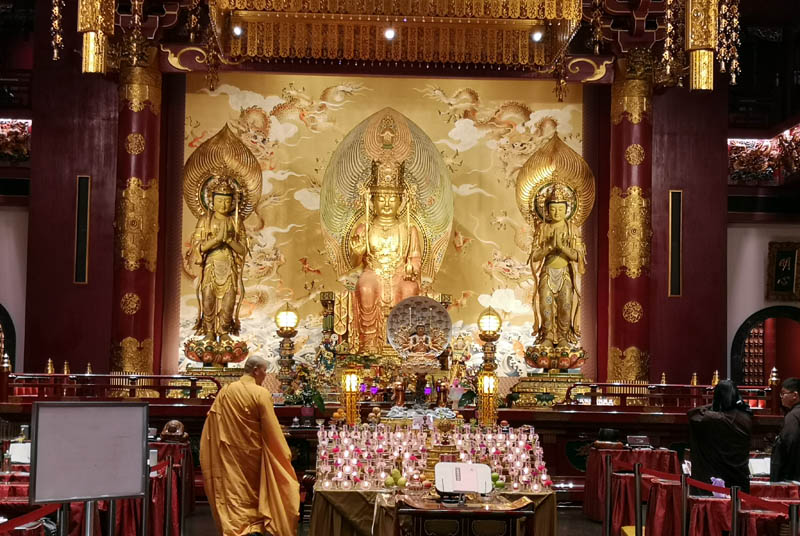
Buddha Tooth Relic Temple
After leaving Thian Hock Keng Temple, we returned toward the center of Chinatown to visit the Buddha Tooth Relic Temple and Museum. Completed in 2007, the temple was designed according to architectural principles of the Tang Dynasty despite being a modern construction. The complex contains several levels, including prayer halls, exhibition galleries, a rooftop garden, and a sacred chamber housing what is believed to be a tooth relic of the Buddha, preserved inside a large golden stupa. During our visit, monks and worshippers moved quietly through the main prayer hall while visitors observed the richly decorated interior. Informational displays throughout the museum explain the development of Buddhism, the significance of relic worship, and the symbolism behind many of the statues and decorative elements found inside the building. The temple also houses a collection of Buddhist art and historical artifacts representing different traditions across Asia.
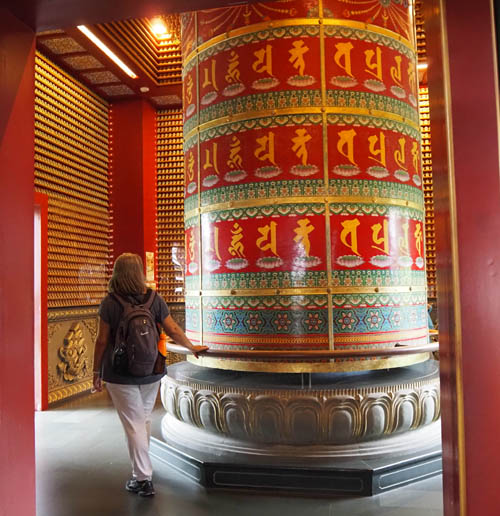
Buddha Tooth Relic Temple - Prayer wheel
Continuing our walking tour, we reached Kreta Ayer Square, one of the principal public spaces in Chinatown. The name "Kreta Ayer" originates from the Malay expression meaning "water cart," referring to the bullock carts that once transported fresh water through the neighborhood before a modern water supply existed. Today, the square serves as an open gathering place surrounded by cafés, restaurants, and restored heritage buildings. During festival periods, temporary stages and decorative installations are erected for cultural performances and community events. From there, we entered Smith Street, historically one of Chinatown's busiest commercial streets and today a pedestrian area covered by a modern canopy. Beneath this structure stand rows of restored nineteenth-century conservation shophouses, protected under Singapore's heritage preservation programme. Their façades display a mixture of Chinese, Malay, and European architectural influences, featuring timber shutters, decorative plasterwork, colorful ceramic tiles, and the characteristic five-foot ways that provide sheltered walkways along the street. Many of these buildings now accommodate restaurants, cafés, souvenir shops, and small businesses, while preserving their original external appearance. Smith Street has long been associated with Singapore's hawker culture and remains one of the best places in Chinatown to experience traditional local cuisine within a historic urban setting.
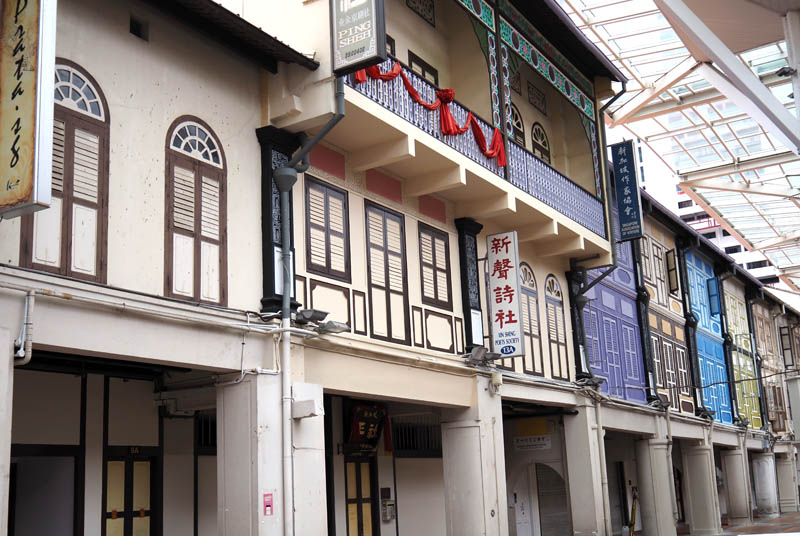
Singapore - Smith St
We concluded our morning by having lunch at Hawker Chan, widely recognized for becoming the world's least expensive restaurant to receive a Michelin star. Originally awarded its star in the Michelin Guide Singapore in 2016, the restaurant became internationally known for serving affordable versions of traditional Cantonese dishes. The signature specialty is soy sauce chicken, prepared using a recipe developed by founder Chan Hon Meng, accompanied by either rice or noodles. Although the restaurant has since expanded beyond its original premises, the Chinatown branch continues to attract visitors interested in experiencing one of Singapore's most famous culinary success stories. Ordering is straightforward, with customers placing their orders at the counter before collecting their trays and finding a seat in the dining area. After lunch, we left Chinatown to continue our exploration of Singapore during the afternoon.